“Unpolished III / Branieschoppers”: The Postmodern Legacy of the Netherlands in the 1980s
Paul Thermos, Peter van Bergen, Willem Breuker
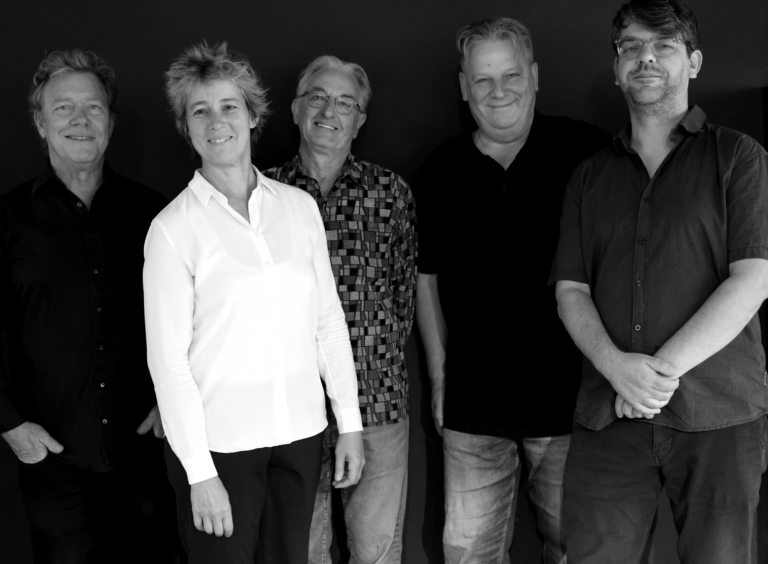
Nieuw Amsterdams Peil is a fairly constant presence in De Link’s program. In recent years, the ensemble has performed programs in Tilburg that focused on musical themes as diverse as the piano trio, the double bass as a leading instrument, and George Crumb’s anti-war activism. This season, with “Unpolished III / Branieschoppers,” the ensemble explores the postmodern legacy of new music from the Netherlands of the 1980s. Works by saxophonists Paul Termos and Peter van Bergen combine elements from both the composed and improvised realms and introduce three iconic miniatures by the groundbreaking and still equally exciting Willem Breuker.
The idea that music must be comforting and beautiful and should make the listener feel good is certainly not a universal truth. To illustrate this, Nieuw Amsterdams Peil takes us back to the late twentieth century. Whether it was contemporary music, pop, or jazz, musicians and composers at the time pushed the boundaries and strayed from the beaten path. Musical styles and mindsets began to influence one another, and musicians certainly did not shy away from taking risks.
One of those pioneers was Willem Breuker. His unparalleled virtuosity, audacity, and vitality became a source of inspiration for others. Saxophonists such as Paul Termos and Peter van Bergen also began to make their mark. Unpolished III delves into the repertoire of these three unconventional performers and composers, bringing the old-fashioned excitement of that era back to the concert hall.
Peter van Bergen’s “Factorseries” formed the core repertoire of the LOOS ensemble. The grid of the compositions is formed by a number of short, composed elements notated in a non-fixed order. It is vital, angular music in which melody, harmony, and rhythm play absolutely equal roles. The idiom is defined by percussive chords of constantly varying duration, together with the intervening silences. The musicians themselves determine the order and the relationship to improvisations of varying lengths during the performance: they are thus the so-called “factors” who ultimately determine the composition, not the composer. The result is a no-man’s-land between composition and improvisation in which a unique tension arises between musicians and their audience, among the musicians themselves, and among the audience members? After all, the audience witnesses the creation of a composition within the possible structures formed by the composed elements. A performance on a knife’s edge.
The composer and saxophonist Paul Termos, who died far too young, was best known for his no-nonsense style of composition. Short motifs, a broken triad, a simple octave: these were always exactly the right ingredients to create a captivating piece.
Willem Breuker wrote Reisefieber for Johan van der Keuken’s 1981 film De weg naar het zuiden. Duke Edward/Misère is an Ellington-inspired lament written for the play Stroman en Trawanten by Freek de Jonge and the Willem Breuker Kollectief.
-
Tu 03 Nov 2026
-
20:00 - 21:00
-
Het Cenakel
-
Tilburg